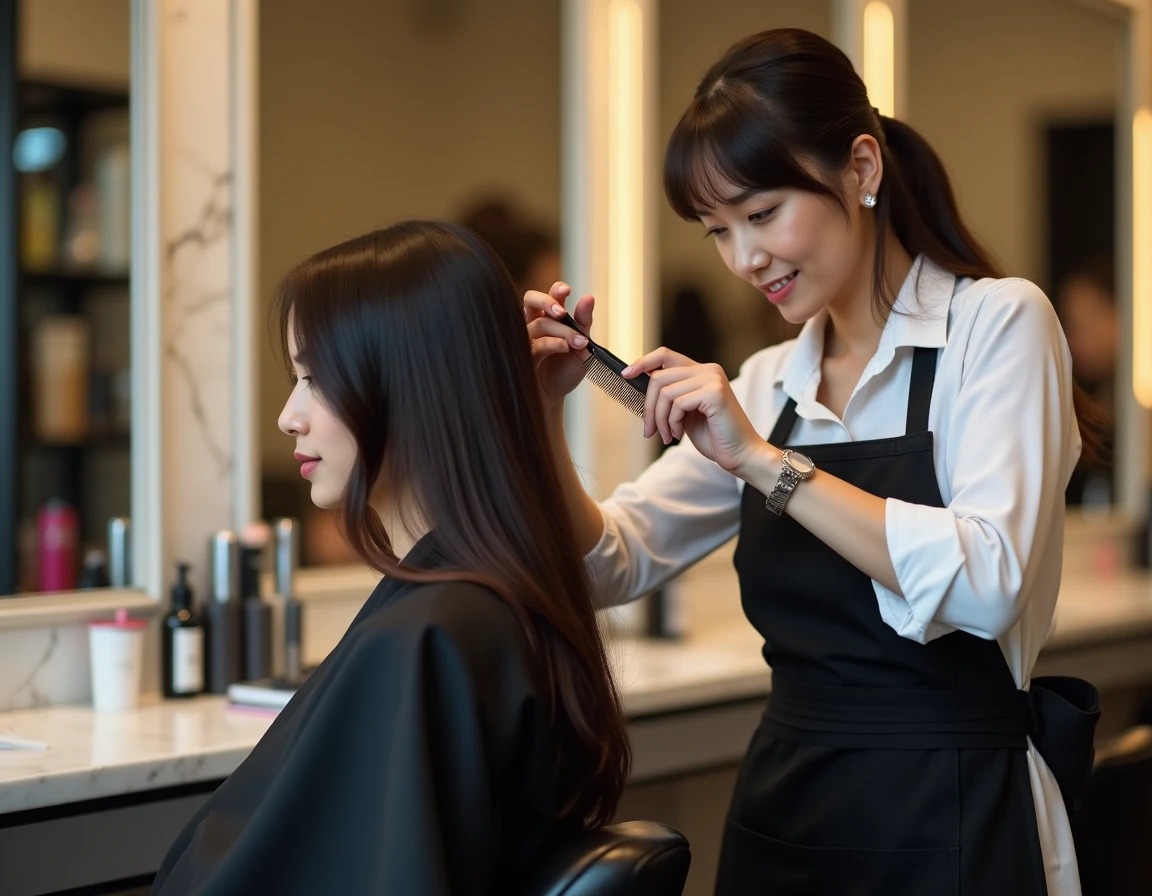
The butterfly cut is based on a principle of layering that seems simple, but its execution varies significantly from one salon to another. Viral videos show the result, rarely the technical dialogue between the client and the hairdresser. Formulating a precise request for a butterfly cut requires understanding the structure of this cut and mastering some professional vocabulary references.
Butterfly Cut and Wolf Cut: Two Gradients That Hairdressers Often Confuse
A point rarely addressed by online tutorials concerns the frequent confusion between the butterfly cut and the wolf cut. Both styles share a pronounced gradient and volume concentrated on the top of the head, which leads some hairdressers to treat them interchangeably.
Recent professional training programs actually cover these two cuts together. JHB Formations offers in 2026 a module titled “Wolf Cut & Butterfly Cut” over one day in Cannes, with a program focused on mastering the two distinct lengths and adapting to fine hair. This pedagogical approach confirms that the butterfly cut is considered a more structured variant of the wolf cut, more suitable for professional contexts.
The difference lies in the placement of the layers. The wolf cut concentrates volume around the jawline with a “wild” effect. The butterfly cut positions the short layer just below the chin, with lengths falling below, creating that wing effect. When making your request, specifying this distinction avoids a result that is misaligned with your expectations. Several methods for formulating this request are detailed on the blog La Petite Emma, with useful visual references.

Technical Vocabulary for Requesting a Butterfly Cut at the Salon
The lack of standardization in hair vocabulary makes communication with the hairdresser delicate. Using the right terms reduces misunderstandings and guides the cut towards the desired result.
Here are the references to integrate into your request:
- Talk about “layers” or “levels” rather than just “gradient,” as the butterfly cut relies on two distinct levels (short on top, long underneath) and not on a gradual fade
- Specify the height of the short layer in relation to the chin: “I want the short strands to stop just below the jawline” is more actionable than a vague reference to “volume”
- Indicate if you want a center part, a common characteristic of this cut, or an off-center part that alters the distribution of movement
- Mention the curtain fringe if you want one, as it is not systematic in all variants of the butterfly cut
Bringing photos from the front and side remains the most reliable way to frame the discussion. Prefer photos of hair textures similar to yours: a butterfly cut on thick hair does not look the same on fine hair.
Butterfly Cut on Fine Hair: A Technical Response, Not Just a Trend
Professional training in 2026 explicitly positions the butterfly cut as a response to the lack of volume in fine hair. The JHB Formations program specifies that specific work on the layers creates volume without resorting to extensions.
For fine hair, the request to the hairdresser must include a detail often forgotten: the thinning technique. Excessive thinning on fine hair removes material where it is already lacking. Ask for a layered cut without thinning the ends to maintain visual thickness at the tips.
However, feedback from the field varies on the adaptation of the butterfly cut to curly hair. Some hairdressers advise against it because curls obscure the layering effect. Others believe that drying with a diffuser sufficiently redefines the layers for the result to work. If your hair curls naturally, first test the cut on a front strand before committing to the whole.
Styling and Maintenance After a Butterfly Cut: What Changes Daily
The butterfly cut requires styling directed outward to reveal the structure of the layers. Without blow-drying or shaping, the two levels of length can appear flat or messy.
Three practical points to evaluate before deciding:
- The daily styling time increases compared to a straight cut: expect a round brush blow-dry to give movement to the short strands
- The frequency of maintenance cuts is more often than for a long cut without layers, as the short layers lose their shape more quickly
- Texturizing products (sea salt spray, volumizing mousse) become allies to maintain the visible separation between the two levels of the cut
If you are not used to styling your hair every morning, ask your hairdresser directly. Request that they show you the appropriate blow-drying technique during the session. A hairdresser trained in this cut will be able to tell you if your natural texture and routine allow you to maintain the result between appointments.
Requesting a Butterfly Cut: Questions to Ask Before the First Snip
The most crucial moment occurs before the scissors cut. Instead of showing a photo and letting the hairdresser interpret, ask targeted questions.
Ask if they have already performed this cut, and on what type of hair. The butterfly cut is now the subject of dedicated professional training, but not all hairdressers have attended them. A trained hairdresser will spontaneously distinguish this cut from a classic gradient.
Inquire about the minimum length required. The butterfly cut works best on medium to long hair, as it needs material to create the two levels. On hair that is too short, the butterfly effect disappears.
Finally, ask for an estimate of the daily styling time for your texture. This question, rarely asked, helps calibrate your expectations and avoid disappointment the next day when the salon blowout is no longer there to structure the layers.