The first aid gestures are based on three fundamental principles summarized by the acronym PAS: Protect, Alert, Rescue. These three steps, applied in this precise order, structure any emergency intervention before the arrival of healthcare professionals. Understanding their logic allows for a methodical response in a situation where every decision counts.
Protect the area before any rescue intervention
The first reflex to adopt in the face of an accident is not to rush to the victim. The priority is to assess the dangers present in the area to avoid a secondary accident. A burning vehicle, a downed power line, a slippery road: these are all risks that can turn a rescuer into an additional victim.
Protecting means acting on the environment, not on the injured person. Marking the road with a warning triangle, turning off the ignition of a crashed vehicle, moving a dangerous object if it can be done safely. If the danger cannot be eliminated, it may sometimes be necessary to move the victim, but only as a last resort.
This step establishes a framework that is often counterintuitive: the desire to help immediately must yield to the analysis of the situation. An injured rescuer mobilizes additional resources and delays the care of the initial victim. Protection thus concerns three concentric circles: oneself, the witnesses present, and then the victim.
To learn first aid gestures, mastering this phase of protection is the foundation upon which everything else relies. Without it, technical gestures lose their effectiveness.

Alerting emergency services: the information that speeds up response
Once the area is secured, the alert must be triggered as soon as possible. Calling 15 (SAMU), 18 (firefighters), or 112 (European emergency number) seems simple, but the quality of the call determines the speed of the response.
The medical dispatcher on the line needs precise information to send the appropriate resources. Here are the details to convey in order:
- The exact location of the accident (address, kilometer point, visual landmarks if necessary), because a poorly oriented emergency vehicle loses precious minutes.
- The nature of the situation (road accident, malaise, fall, burn) and the number of victims, so that the dispatch center can size its intervention correctly.
- The apparent condition of the victim (conscious or not, breathing or not, bleeding profusely or not), as these elements allow the dispatcher to provide appropriate instructions over the phone.
- The gestures already performed and the persistent risks (gas leak, fire), so that the teams arrive prepared.
A often overlooked point: never hang up before the dispatcher asks you to. They can guide the actions while waiting for help to arrive. The call is not just a transmission of information; it is a channel for real-time technical support.
Delegate the call when possible
If witnesses are present, assigning the call to an identified person (by directly pointing them out, not by making a vague call to the crowd) frees the main responder to move on to the third step. Giving a precise instruction works better than a general request: “You, in the blue jacket, call 15 and come back to tell me what they said.”
Rescue a victim: first aid gestures adapted to the situation
The actual rescue phase only begins after protection and alerting. This sequencing is not arbitrary: it ensures that the intervention takes place in a safe environment, with reinforcements on the way.
Rescuing does not mean making a medical diagnosis. It involves applying simple, standardized gestures that stabilize the victim’s condition. The recovery position (PLS) is the most well-known example: it concerns an unconscious person who is breathing and prevents airway obstruction by the tongue or vomit.
Adapt the gesture to the identified problem
Each situation calls for a different response. Three scenarios cover the majority of emergencies encountered by the general public:
- Unconscious victim who is breathing: check for breathing (look at the chest, listen, feel for breath), then place in the recovery position while waiting for help.
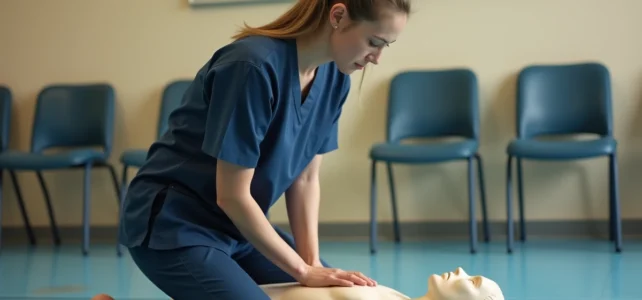
- Unconscious victim who is not breathing: immediately begin chest compressions (compressions in the center of the chest, at a steady rhythm) and use an automated external defibrillator if available.
- Severe external bleeding: apply direct pressure to the wound with a clean cloth or, if unavailable, with your hand, maintaining pressure without releasing until help arrives.
The effectiveness of these gestures relies on their rapid execution, not on their technical perfection. An imperfect chest compression is always better than no compression at all. The fear of doing it wrong paralyzes more than the lack of training.

Why the PSC1 training remains the best framework for practice
The Level 1 Prevention and First Aid Training (PSC1) is the reference program in France for acquiring these gestures. It takes place over one day and alternates theoretical input with practical simulations.
The main benefit of this training lies in the repetition of gestures on a mannequin. Reading a technical sheet on the recovery position and practicing it on a dummy are two radically different experiences. The muscle memory acquired in training allows for the gesture to be reproduced under stress, where theoretical knowledge often collapses.
Accredited organizations (Red Cross, Civil Protection, local civil security associations) offer these sessions throughout the year. Some municipalities or companies organize them for free for their residents or employees.
The PAS framework (Protect, Alert, Rescue) remains the same regardless of the severity of the situation. Its strength lies in its simplicity: three memorable steps that provide a decision-making structure when stress clouds judgment. Mastering this triptych means having a reflex that can be applied anywhere, without specialized equipment.