
The choice of a motorcycle after 60 years old relies on biomechanical parameters that general guides rarely address. Seat height, weight in running order, steering angle, footpeg position: these data determine the ability to place feet at a stop, maneuver at low speed, and ride for several hours without cervical or lumbar pain. Here, we detail the technical criteria that separate a suitable motorcycle from one that is simply comfortable on paper.
Ergonomics of the riding position: the dimensions that really matter
Seat height alone is not enough to assess the accessibility of a motorcycle. It is the seat-handlebar-footpeg triangle that determines the rider’s actual posture. A handlebar that is too low forces a bend in the torso that overloads the trapezius and wrists, while rearward footpegs excessively bend the knees.
On a trail bike like the Honda NC750X, the high handlebars and advanced footpegs place the torso nearly vertical. This geometry reduces pressure on the lumbar discs during long rides. In contrast, a sport roadster like the Yamaha MT-07, despite a low seat, leans the rider forward and quickly fatigues the shoulders.
We recommend checking three dimensions before any test ride: the effective seat height (measured with the rider seated, suspension compressed), the angle of the handlebars relative to the horizontal plane, and the seat-footpeg distance. A serious dealer will provide these values. To delve deeper into the question of which motorcycle for seniors based on their morphology, these parameters are the starting point.
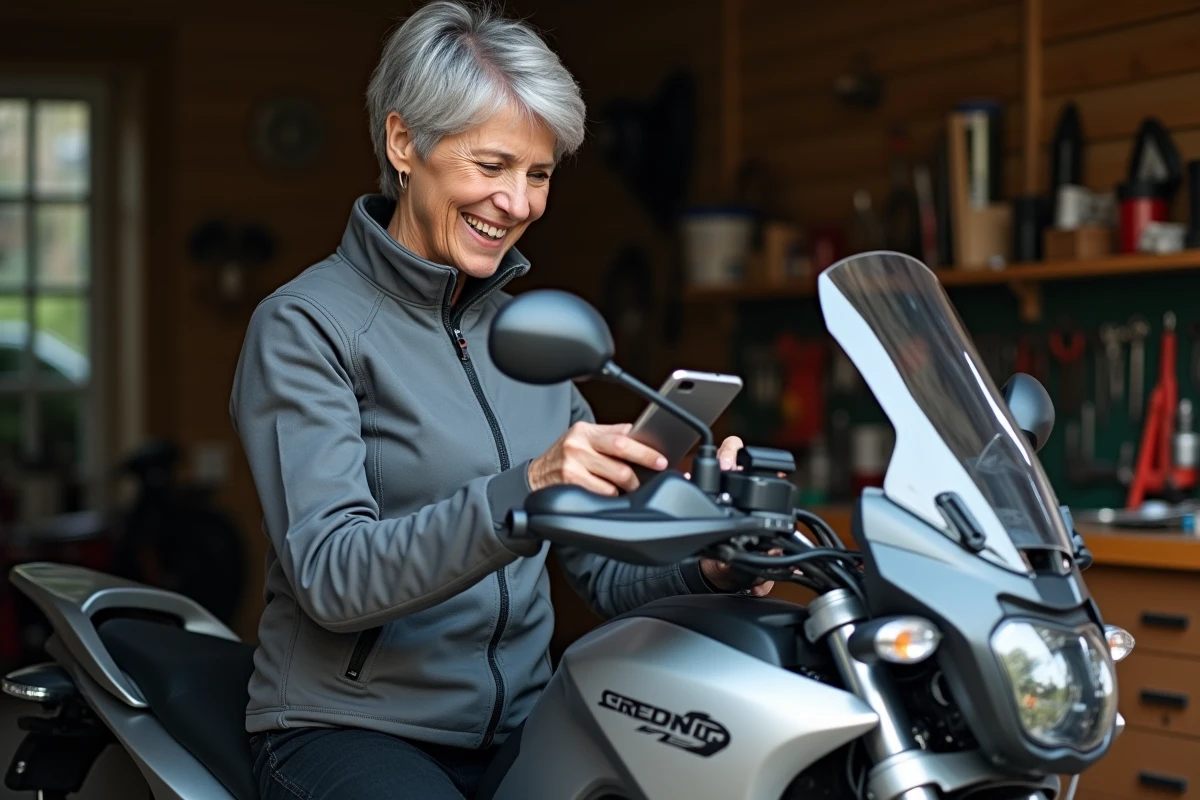
Weight in running order and low-speed maneuvers
The weight of the motorcycle is the number one limiting factor after 65 years. The gradual loss of muscle mass reduces the ability to hold a machine at a stop or in a tight turn. A touring motorcycle that exceeds two hundred kilograms becomes a concrete risk of falling when stationary, not while riding.
The Honda Gold Wing, often recommended for comfort in two-up riding, is also one of the heaviest on the market. A rider who hasn’t ridden for several years or who notices a decrease in arm strength would benefit more from turning to lighter machines.
Mid-size trails (Honda CB500X, Suzuki V-Strom 650, Kawasaki Versys 650) offer an interesting compromise:
- A moderate weight in running order, allowing for correction of an imbalance at a stop without straining
- An adjustable seat height on certain models thanks to manufacturer kits
- Sufficient aerodynamic protection for highway trips, with an adjustable windscreen
- A relatively low center of gravity that facilitates parking maneuvers
The GT scooter (like the Honda Forza or Yamaha TMAX) also deserves consideration. The automatic transmission eliminates the effort of the clutch lever, and the flat floor makes it easier to place feet. We observe that many senior riders dismiss this option due to a cultural attachment to the “real” motorcycle, while the gain in daily comfort is considerable.
Seat and suspensions: long-distance comfort is not just about padding
A thick seat does not equate to comfort. The shape of the seat and the density of the foam matter more than the thickness. A seat that is too soft compresses after an hour of riding and leaves the pelvis resting on the rigid shell. Replacement gel seats, offered by specialized saddle makers, maintain consistent support over several hours.
Suspensions play at least as crucial a role. A poorly calibrated fork and shock absorber transmit every imperfection of the road to the lumbar and cervical areas. Motorcycles equipped with adjustable preload suspensions allow for hardness adaptation based on the rider’s weight (and the passenger in two-up riding). Semi-active systems, available on some high-end models, automatically adjust damping in real-time.
For two-up use, the quality of the passenger seat and grab handles deserves equal attention. A poorly positioned passenger alters the motorcycle’s dynamic behavior and fatigues the rider through involuntary movements.

Electronic aids and active safety for senior riders
Electronic aids are not a gimmick on a motorcycle intended for a senior rider. ABS is now mandatory on new motorcycles, but not all calibrations are equal. A cornering ABS significantly reduces the risk of falling in curves, a situation where reflexes must be instantaneous.
Traction control (TC) limits rear wheel slip on wet surfaces or during hard acceleration. The quickshifter, which allows shifting gears without using the clutch, relieves the left hand on long rides. These features, once reserved for sportbikes, are becoming common on trails and touring bikes.
Three active safety criteria to check before purchase:
- The presence of a switchable ABS or not (in light off-road, a non-switchable ABS can be cumbersome)
- The number of riding modes offered, with at least one “rain” mode that softens throttle response
- Adaptive LED lighting, which improves nighttime visibility without dazzling oncoming vehicles
The question of skill refreshment deserves to be asked frankly. A rider returning after ten or fifteen years off will not regain their reflexes in just a few kilometers. Improvement courses, offered by most circuits and some associations, allow for recalibrating reflexes in a safe environment. Good electronic equipment does not replace manual mastery.
The final choice depends on a personal trade-off between weight, comfort, budget, and type of trips. But this trade-off can only be rational after a real test ride, in traffic conditions, not just in a dealership parking lot. Demand a road test of at least thirty minutes, ideally with the usual passenger.