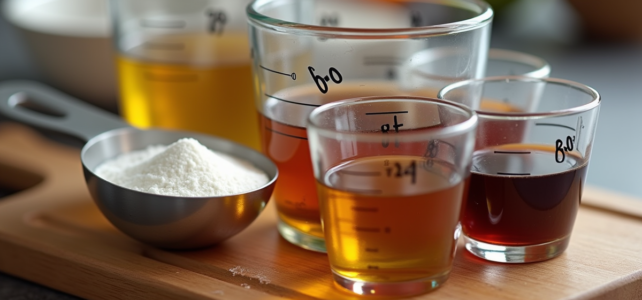
In cooking, precision is often the key to successfully executing a recipe. Whether you are an amateur cook or a seasoned chef, you need to master the conversions of liquid measurements. Switching from milliliters to cups, or ounces to liters, may seem complicated, but a few simple tips can greatly simplify the process.
Imagine preparing an international recipe with measurements different from those you are used to. Knowing how to convert these units effortlessly allows you to faithfully follow the recipe, thus avoiding any mistakes that could alter the taste or texture of the dish. Here are some practical tips to help you navigate in no time.
The Basics of Liquid Measurement Conversion in Cooking
Understanding liquid measurement conversions is essential for successfully executing your recipes. Measurement units such as milliliters, centiliters, deciliters, and liters are often used interchangeably, but each has its specificity. Here are some key data to guide you.
Milliliters (ml): A milliliter is the base unit for measuring liquids. 1 ml equals 0.001 liters. To convert 250 ml to liters, simply divide by 1000.
Centiliters (cl): A centiliter is equivalent to 10 milliliters. To convert milliliters to centiliters, simply divide by 10. For example, 50 ml becomes 5 cl.
Deciliters (dl): A deciliter corresponds to 100 milliliters or 10 centiliters. Converting milliliters to deciliters requires dividing by 100.
Liters (L): The unit most commonly used for large volumes. 1 liter equals 1000 milliliters or 100 centiliters.
| Unit | Equivalence |
|---|---|
| 1 ml | 0.001 liter |
| 1 cl | 10 ml |
| 1 dl | 10 cl or 100 ml |
| 1 liter | 100 cl or 1000 ml |
Using a conversion chart can greatly facilitate cooking. These tools allow you to quickly and accurately convert the measurements of your liquid ingredients, whether it’s water, milk, or oils. 
Tips and Practical Advice for Accurate Conversions
To ensure the accuracy of your conversions in cooking, use appropriate tools and adopt proven methods. Here are some recommendations to avoid measurement errors.
Use graduated utensils: Measuring cups and spoons are essential for measuring liquids. They allow for easy conversion between milliliters, centiliters, and deciliters. Prefer glass or clear plastic utensils for more accurate readings.
Invest in a digital scale: A quality digital scale makes it easier to convert volumes to weight. For ingredients like flour, sugar, or butter, note that 1 deciliter (dl) of flour corresponds to 50 grams (g), while 1 dl of sugar equals 85 g and 1 dl of butter equals 90 g. This data will help you adapt your recipes accurately.
Use online converters: Many websites offer unit conversion tools. These converters allow for quick switching between the metric system and the imperial system, and vice versa. They are particularly useful for international recipes.
- Metric System: Primarily used in Europe and many other countries, this system relies on units of milliliters, centiliters, deciliters, and liters.
- Imperial System: Primarily used in the United States, it includes units such as fluid ounces (fl oz), cups, and pints.
To avoid common mistakes, always double-check your measurements. A good practice is to use the same utensils for all your conversions to ensure consistency and accuracy.
These tips will allow you to easily navigate between different units of measurement and ensure reliable results in all your culinary preparations.