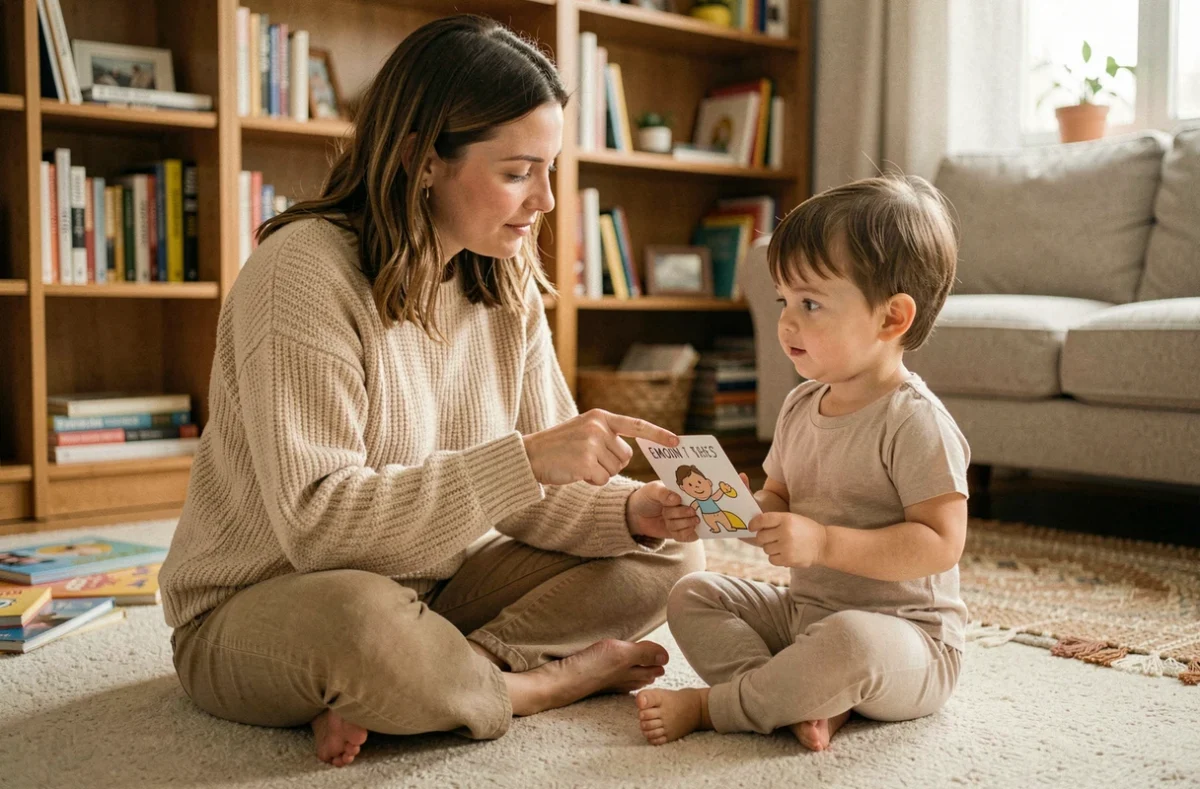
Children begin to distinguish between basic emotions (joy, anger, fear, sadness) long before they know how to name them. Exploratory research with children aged 3 to 5 shows that, in a safe environment and with appropriate resources, even the youngest children can talk about how they feel and identify the people who comfort them.
Parents don’t have to figure everything out on their own: children also learn about emotions at school, in after-school programs and with other trusted adults.
When children open up to someone outside the home
Some children find it easier to talk about their emotions with a teacher, activity leader or grandparent than with their parents. This can be unsettling, but it’s nothing to worry about. The exploratory study mentioned above found that young children naturally see adults at school as sources of support and comfort, just like their parents.
A child who chooses to talk to someone else isn’t rejecting their family. They’re trying out a different setting, one that may feel less emotionally charged. Pressuring them to open up can have the opposite effect: they shut down.
The most practical approach is to check in regularly with the teacher or school staff to identify situations that trigger strong emotions (a conflict with a classmate, frustration during an activity, separation in the morning). Sharing these observations helps provide consistency: the same cues and the same words in both settings. Douceur Enfance’s tips for helping children manage their emotions offer several ideas for building this connection between home and the other places where children spend time.

Naming children’s emotions: techniques and limitations
Putting a name to what a child is feeling remains the first strategy recommended by early childhood professionals. Saying “you seem angry” or “I can see you’re sad” helps children connect a physical sensation (a tight throat, clenched fists) with a concept they can use again.
Practical tools to help children express themselves
It’s unrealistic to expect a three- or four-year-old to explain how they feel inside using complete sentences. Visual and storytelling tools can help bridge the gap:
- Stories read aloud or told, in which a character experiences a recognizable emotion, let children say “me too” or “he’s angry” without talking directly about themselves
- Comfort objects (a stuffed animal, puppet or drawing) offer an intermediary: children project their feelings onto the object, making it less daunting to put them into words directly
- Simple role-play games, where parent and child switch roles, help children explore a real-life situation from another perspective
The pilot study of children aged 3 to 5 confirms that these accessible tools help young children express themselves. Its small sample size means the findings can’t be generalized, but the approach is consistent with the practices of early childhood professionals.
What putting feelings into words can’t solve
Naming an emotion doesn’t make it go away. A child who can say “I’m angry” still feels just as intensely. Putting feelings into words is a starting point, not a complete solution. It should be paired with physical strategies such as slow breathing, movement or taking a short break in a quiet space.
Bringing families, schools and professionals together to help children manage emotions
As part of an initiative by the Regional Health Agency of Réunion, Santé publique France describes an approach that brings together families, schools, after-school programs and professionals to support children’s social and emotional skills. The guiding principle is that consistent emotional cues across the different settings in a child’s life support learning more effectively than working on it at home alone.
Structured support programs are available for families who want them. The Regional Health Agency of Île-de-France describes the Family and Parenting Support Program (PSFP), which offers joint workshops for parents and children aged 6–11. This kind of program isn’t limited to a one-off activity: it runs over time and is adapted to participants’ ages.
What parents can do without a formal program
Not every family has access to a structured program, and many don’t need one. A few regular practices are enough to create a supportive environment:
- Set aside a short time each day (after school or at bedtime) to ask, “What made you happy or annoyed today?” without pressing if your child doesn’t answer
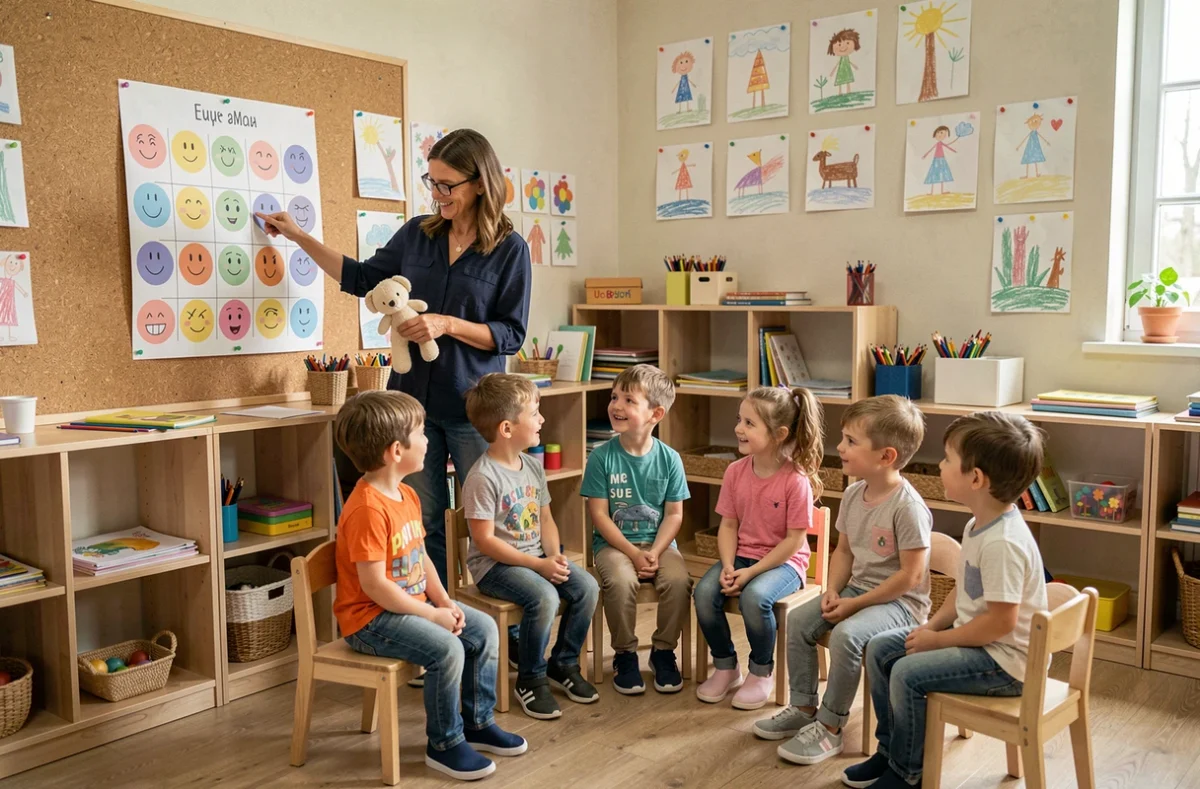
- Use the same emotional vocabulary as the teacher: if the class uses a color-coded emotions chart, use those colors at home too
- Accept silence, because a child who doesn’t put their feelings into words isn’t necessarily struggling: some children express themselves through drawing, play or simply a hug
- Avoid routinely discussing your child’s emotions in front of other adults, as this may embarrass them and make them less likely to open up in the future
Anger, fear, sadness: tailor your response to each emotion
It’s tempting to respond to every emotion in the same way, but that’s rarely effective. Anger often calls for a chance to release physical tension before talking. Fear calls for a reassuring presence and validation (“it’s normal to feel scared”) rather than an immediate rational explanation. Sadness, meanwhile, mostly calls for quiet, attentive company.
Every emotion has its own pace, so it helps for parents to observe before stepping in. A child in the middle of an angry outburst won’t hear what you’re saying: it’s better to stay close, keep them safe, and talk about what happened once they’ve calmed down.
A common mistake is trying to rush the return to calm. Phrases like “it’s not a big deal” or “stop crying” cut off the emotional response without resolving it. Accepting the emotion without trying to hurry it along is the most protective response in the long run.
Learning about emotions has no end date. The foundations laid between ages 3 and 6 (naming, accepting and managing emotions) become more complex with age, but the basics remain the same. Children who grow up in an environment where their emotions are taken seriously have a solid foundation for the future, whether at home, at school or in their relationships with others.